DDR5 vs DDR4 in 2026: Which Memory Should You Buy Right Now?
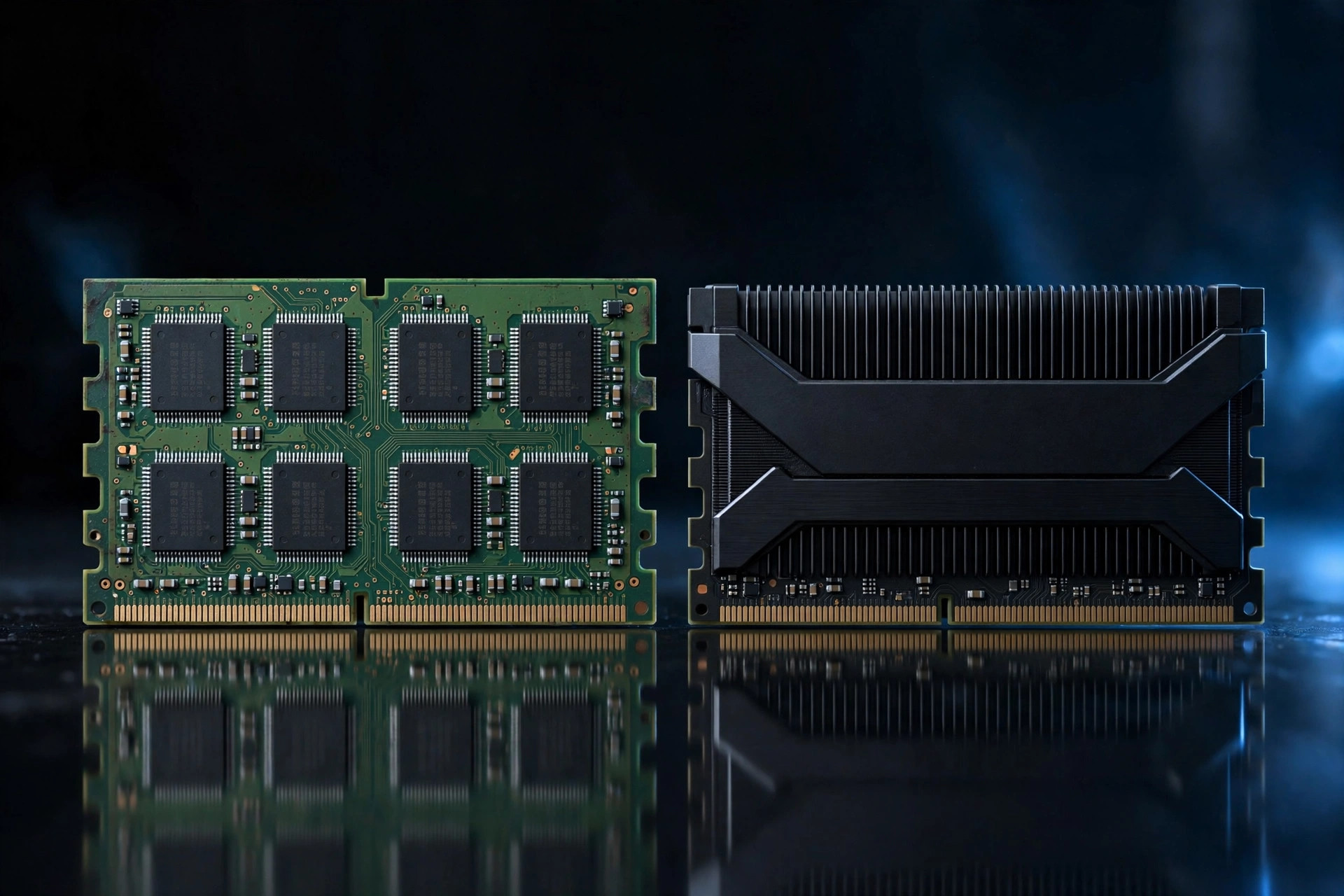
For years the advice was simple: DDR5 for new builds, DDR4 for budget upgrades. The 2026 memory crunch broke that script — and the right choice now depends on details most guides skip. The DDR5 vs DDR4 question used to be about performance per dollar; today it is about platform longevity, availability, and a market where the old budget option stopped being cheap.
The market reality
DDR5 prices have roughly quadrupled since mid-2025 as AI-driven HBM demand starved consumer DRAM supply. DDR4 was supposed to be the refuge — instead it entered a "legacy rally": with manufacturers winding down DDR4 production, quarterly price jumps of up to 50% have, in some regions, pushed DDR4 to per-gigabyte parity with DDR5.
Neither generation is cheap. The question is which gives you more for the money.
The mechanics are straightforward and worth understanding, because they explain why the old advice died. HBM — the stacked memory feeding AI accelerators — now absorbs a large share of industry fab capacity and commands premium margins, so the big DRAM makers allocate wafers accordingly. Consumer DDR5 gets what's left, at higher contract prices. DDR4, meanwhile, is a shrinking pie: as manufacturers wind down DDR4 lines to free capacity, supply falls faster than demand, and the remaining kits get bid up. A "legacy rally" is what happens when everyone who still needs the old standard is buying from a shrinking pool. If you want the full picture of how AI memory demand is distorting the market, our DRAM price surge breakdown tracks the numbers quarter by quarter.
DDR5 vs DDR4: the technical comparison
| DDR4 | DDR5 | |
|---|---|---|
| Base speeds | 2133–3200 MT/s | 4800–8400+ MT/s |
| Typical enthusiast kits | 3600 CL16 | 6000 CL30 |
| Voltage | 1.2V (1.35V XMP) | 1.1V (1.25–1.4V XMP/EXPO) |
| Channels per DIMM | Single 64-bit | Dual 32-bit subchannels |
| On-die ECC | No | Yes |
| Power management | On motherboard | On-DIMM PMIC |
| Max practical DIMM size | 32GB | 64GB+ (128GB emerging) |
| Platform status | End of life — AM4, older LGA1700 | Current — AM5, LGA1700/1851 |
The architectural differences matter more than the megatransfer gap suggests. DDR5's dual 32-bit subchannels per DIMM improve effective bandwidth for the small, scattered accesses that real software performs; on-die ECC corrects single-bit errors inside each chip (a reliability floor DDR4 never had); and the on-DIMM PMIC gives finer-grained power control, which is part of why DDR5 scales to higher densities. None of this makes DDR4 bad — a 32GB DDR4-3600 CL16 kit remains a genuinely good memory subsystem — but it explains why every new platform is DDR5-only and why DDR4 has no future beyond keeping existing machines alive.
The decision framework
Buy DDR5 if: you're building new on a current platform (AM5, LGA1700/1851). The platform requires it, and DDR5-6000 CL30 remains the sweet spot for gaming. Our DDR5-6400 vs DDR5-6000 for gaming breakdown tests whether the faster bins are actually worth their premium. You also get a real upgrade path — your next CPU will want DDR5 anyway. In the 2026 market the best DDR5 RAM buys are unglamorous: 32GB at 6000MT/s CL30 from an established line, validated on your board's QVL, with no halo-frequency premium attached.
Buy DDR4 if: you're extending the life of an existing DDR4 system (AM4, LGA1700 DDR4 boards). A 32GB DDR4 kit can still be found at sane-ish prices and will keep a Ryzen 5000 machine competitive for years — those CPUs remain excellent, and DDR4-3600 CL16 feeds them well. Do not buy into a DDR4 platform new in 2026 — it's a dead end with no upgrade path, and at per-gigabyte parity with DDR5 you'd be paying current-generation money for a last-generation ceiling.
Buy neither yet if: your system runs fine. Memory is the worst value component in the PC market right now. An SSD upgrade delivers far more noticeable improvement per dollar — and if you're unsure how much memory your workload actually wants, our RAM capacity guide will talk you out of overspending before you open your wallet.
Specs that matter in 2026
- Capacity over speed. 32GB of DDR5-5600 beats 16GB of DDR5-7200 for nearly everyone. Don't pay the frequency premium while prices are inflated — and if you're tempted by halo kits, read our DDR5-8000 vs DDR5-6000 breakdown first: the real-world gaming gap is 2–5%, invisible in play.
- Latency still counts. For DDR5, 6000MT/s at CL30 remains the price/performance knee. True latency in nanoseconds is (CAS ÷ frequency) × 2000 — DDR5-6000 CL30 and DDR5-8000 CL40 both work out to 10ns, which is why tight timings at moderate speeds keep winning.
- Check QVL lists. With supply tight, motherboard vendors validate fewer kits — but an unvalidated kit that won't boot at XMP is a costly return. This matters more than ever in 2026: return shipping on a kit you waited three weeks for is its own special pain.
- Match the kit to the platform. Intel XMP and AMD EXPO are not interchangeable — buy the profile your board supports, or a kit carrying both. Running four DIMMs? Expect lower achievable speeds than two; daisy-chain board topologies punish fully populated slots.
The upgrade-path argument (and when it doesn't apply)
The strongest case for DDR5 in 2026 isn't performance — it's optionality. An AM5 or LGA1851 board bought today takes whatever DDR5 kits exist tomorrow: denser modules, better bins, lower prices when the market normalizes. A DDR4 board bought today takes DDR4, forever, from a shrinking supply pool at rally prices. Platform longevity is a financial argument disguised as a technical one.
But optionality has a price, and it's worth naming the case where DDR4 wins outright: the machine you already own. A Ryzen 5000 system with 16GB of DDR4-3200 gets transformative life extension from a 32GB DDR4-3600 kit — often the cheapest meaningful upgrade available for that box, cheaper than any platform migration, and the CPU is still fast enough that memory isn't the bottleneck. Sunk cost is only a fallacy when the existing asset is worthless; a good AM4 machine is not worthless.
The same logic extends to laptops, with one caveat: many modern laptops solder their memory, DDR4 or DDR5 alike. See our laptop RAM upgrade guide for the SODIMM vs soldered reality and how to check what your machine supports. If your RAM is fixed, the generation debate is moot — your upgrade budget goes to storage, full stop.
What about waiting?
The honest answer: nobody knows when DRAM normalizes. Contract prices move on fab allocation decisions made quarters in advance, HBM demand shows no sign of softening, and DDR4 supply only shrinks from here. Waiting is rational if your system works — memory is genuinely the worst value in the PC market right now — but waiting as a strategy for a machine that stutters daily is just paying the tax in frustration instead of money.
If you do wait, wait productively: put the budget into the SSD, which is both cheaper per unit of perceptible improvement and unaffected by the DRAM crunch's worst dynamics. When memory prices eventually ease, you'll be upgrading a machine that's already fast rather than rescuing one that's slow.
FAQ
Is DDR4 still worth buying in 2026?
For an existing DDR4 system, yes — a capacity bump to 32GB keeps AM4 and DDR4-LGA1700 machines competitive for years. For a new build, no: DDR4 platforms are a dead end with no upgrade path, and at per-gigabyte parity with DDR5 in some regions, you'd pay modern money for a legacy ceiling.
Is DDR5 worth it over DDR4 for gaming?
On a new build, the question answers itself — current platforms require DDR5. For an existing DDR4 gaming rig, the answer is no: the gaming difference between good DDR4-3600 and DDR5-6000 is small, and a platform migration for memory alone is terrible value. Upgrade the GPU or SSD instead.
Will DDR4 get cheaper again?
Unlikely in any sustained way. Manufacturers are winding down DDR4 production to free fab capacity for DDR5 and HBM, so supply shrinks while a large installed base still needs it — the recipe for the "legacy rally" we're seeing. Expect volatility, not relief.
What DDR5 speed should I buy in 2026?
DDR5-6000 CL30 for nearly everyone — it's the price/performance knee for gaming and general use. Don't pay the halo-frequency premium while prices are inflated; capacity upgrades beat speed upgrades at every budget.
Can I mix DDR4 and DDR5?
No. They are physically and electrically incompatible — different slots, different notches, different controllers. A motherboard takes one or the other, never both. (A few transitional LGA1700 boards came in separate DDR4 and DDR5 variants; the board you own determines which.)
Bottom line: New build? DDR5, no question — buy 32GB at 6000MT/s CL30 and ignore the halo kits. Existing DDR4 rig? A capacity bump is fine and often the smartest money you'll spend. Anything else? Wait — your wallet will thank you, and your SSD budget will thank you louder.